

The Mysterious Galaxy – Continued
After publishing my initial findings on the Mysterious Object near Hickson 68, I kept digging. I also reached out to fellow astrophotographers and amateur researchers to help with catalog queries and coordinate validation. What followed was a deep collaborative effort — one that shows just how layered and sometimes frustrating astronomical identification can be.
Alright! So after a lot of research and help from my friends, a match was finally found on the Galaxy object that I was researching as potentially uncatalogued! While that is mildly disappointing, it’s all good and the entire research process was fun and interesting! I’m definitely going to keep looking for unidentified objects in my images and going through this process will make it an even smoother process going forward! So thanks @Naztronomy and @DeepSpaceAstro for your research assistance!
Why This Was Tricky
One reason this object slipped through initial searches was the inconsistency between catalog indexing methods. Many automated tools rely on nearby named or classified entries, and may not return deeper objects if they lack certain flags. In this case, the SDSS Navigate Tool and SIMBAD API queries failed to catch the object, even though it was plainly visible when using the manual SDSS SkyServer advanced search.
Final Research Summary:
Catalogs Searched (No Match Found): (Automated = queried via API, script, or online tool UI; Manual = direct coordinate-based inspection)
- SIMBAD (Automated)
- CDS Portal (Cone and Table Queries)(Automated)
- SDSS Navigate Tool (Automated)
- Pan-STARRS (Manual via web cutout search)
- NASA Sky Server Survey (Manual image inspection)
- Stellarium (Manual sky rendering)
- 2MASS (Automated file search)
- Gaia DR3 (local file) (Manual / extracted via PixInsight photometry)
- SDSS DR12 (archived CSV)
- (Automated bulk data query)
- VizieR Image Archive (Automated cutout search)
- VizieR Spectral Archive (Automated cone search)
Summary
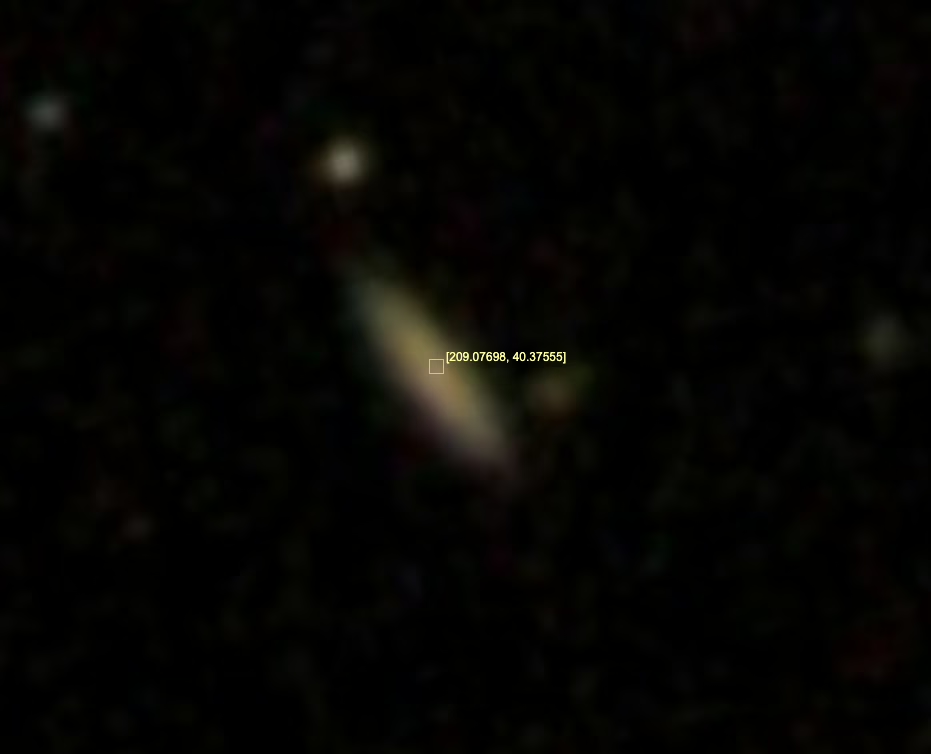
After an extensive multi-catalog search, Candidate Object A was ultimately identified in the SDSS database via the SkyServer interface. The object appears as a GALAXY with the following attributes:
- SDSS ObjID: 1237662307261087876
- RA/Dec: 209.076982164, +40.375554166
- Classification: GALAXY
This match was not returned in prior automated queries via the SDSS Navigate Tool, SIMBAD, or CDS Portal, and was instead discovered through a direct coordinate-based lookup using SkyServer’s advanced object search tools. Its late discovery reinforces the challenges of comprehensive catalog cross-referencing and highlights the importance of manual follow-up even when automated searches return null results.
Why I’ll Keep Hunting
Even though this one turned out to be catalogued, the process itself was worth it. It sharpened my workflow, introduced me to new tools, and gave me a better sense of where automated pipelines fall short. There’s something deeply satisfying about chasing down coordinates through dusty databases and discovering how the sky is mapped behind the scenes. This won’t be the last time I go galaxy hunting — and next time, I’ll be better prepared from the start.
What I Learned
This experience was a great reminder that while automation is powerful, it can’t always replace careful human inspection. A faint galaxy buried in a crowded starfield won’t always trip the right algorithmic wire. I’m more confident now in my ability to run multi-catalog searches, parse sky survey data, and know when to stop trusting the query and start trusting my eyes. Even though this didn’t result in a new discovery, I learned so much going through the process!
Next Time!!
Cheers!
Doug
Leave a Reply