
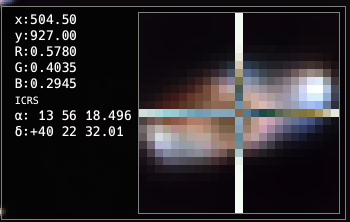
While imaging the Hickson 68 galaxy group on February 10, 2025, I noticed a faint, elongated object near pixel coordinates (504.5, 927.0) in my final stacked image. This object appeared distinct from stars, showing structure consistent with a small galaxy. What followed was a deep-dive into astrometric tools and catalogs to determine whether this was a known object—or something new.

Before the discovery
While targeting Hickson 68, I wasn’t expecting anything unusual. This compact galaxy group in Canes Venatici is a well-known playground for deep-sky imagers. My plan was to refine my capture and processing workflow using broadband and narrowband filters—nothing more. But as I reviewed the stack, something unexpected emerged…
The Discovery
- Object: Candidate Galaxy in Hickson 68 field
- Date: 2025-02-10
- Coordinates (ICRS): RA 13h 56m 18.496s, Dec +40° 22′ 32.01″
- Decimal Degrees: RA 208.57707°, Dec +40.375558°
- Pixel Location: (504.5, 927.0)
- Equipment: EdgeHD 8 / Artemis-M PRO
- Exposure: 35:05 Hrs Total Integration, mixed filters
What Makes an Object a Galaxy?
When distinguishing a small galaxy from a star or artifact, several factors come into play. Shape is a big one—galaxies tend to show elongation or diffuse structure, unlike pinpoint stars. Color balance and flux profiles across filters can also help. In this case, the RGB bias and visible extension pointed away from a stellar object.
Initial Observations
- The object appeared faint, extended, and structured—distinct from point sources like stars.
- RGB values measured: R=0.5780, G=0.4035, B=0.2945
- Crosshairs in the FITS viewer confirmed ICRS coordinates using WCS metadata from the image header
Catalog Search Results
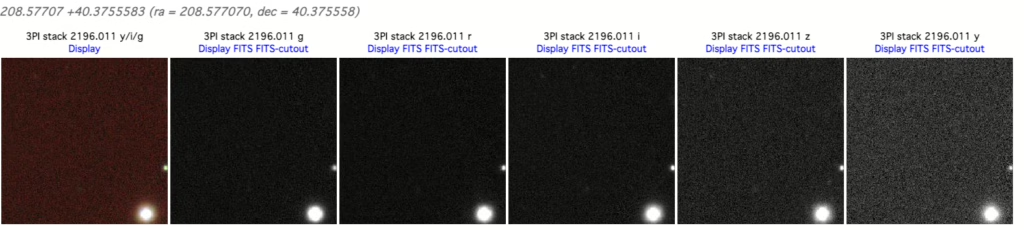
I initially assumed it would show up in SDSS or Pan-STARRS, but after zooming and blinking between bands, I realized nothing aligned. I double-checked coordinates using WCS data embedded in the FITS header, confirmed the location in astrometry.net, and even tried Aladin. Still nothing.
- SIMBAD: No objects found within 2 arcminutes
- SDSS: Navigate tool returned “No objects found within 0.2 arcmin”
- Pan-STARRS: Imaging shows no visible object at the exact coordinate center in any band (g, r, i, z, y)
Conclusion
I’ve been down these rabbit holes before, but something about this one felt different. The object had presence—not just in shape, but in how it resisted identification. I triple-checked my processing, confirmed the coordinates, and even had two friends independently verify the field. Every step just deepened the mystery. Whether it’s a faint dwarf galaxy, an unknown background object, or something else entirely, the possibility of finding something unlisted kept me coming back.
This object currently appears to be uncatalogued in major astronomical databases. Further investigation—including deeper imaging or spectroscopy—may be warranted. For now, it remains an intriguing ghost in the Hickson 68 field. As astrophotographers, we often chase beauty—but moments like this remind me we’re also data collectors, sometimes stumbling into science. Whether this object turns out to be known or new, that thrill of the unknown is why I keep pointing my telescope upward.
Next Steps
- Submit to Pan-STARRS Cutout viewer with broader FOV
- Prepare for possible TNS or preprint if future data supports a unique or transient classification
- Share findings with the amateur/pro-am astronomy community
Stay tuned… this one might have a story to tell.
Cheers!
Doug
Leave a Reply