
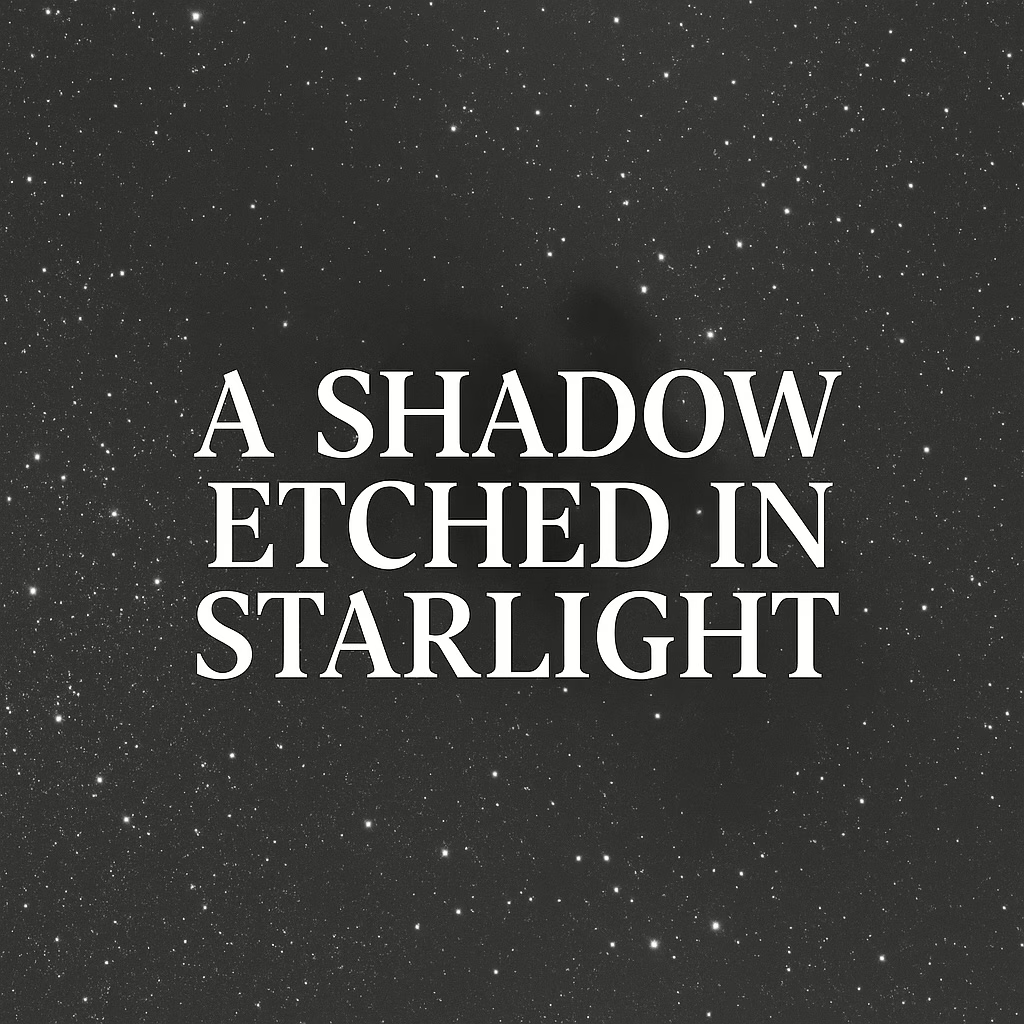
Colorado Dark Skies – Imaging The Invisible!
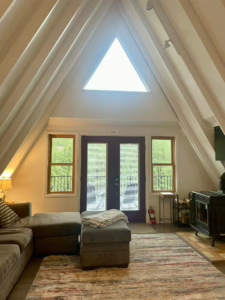
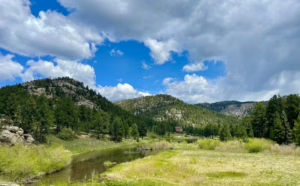
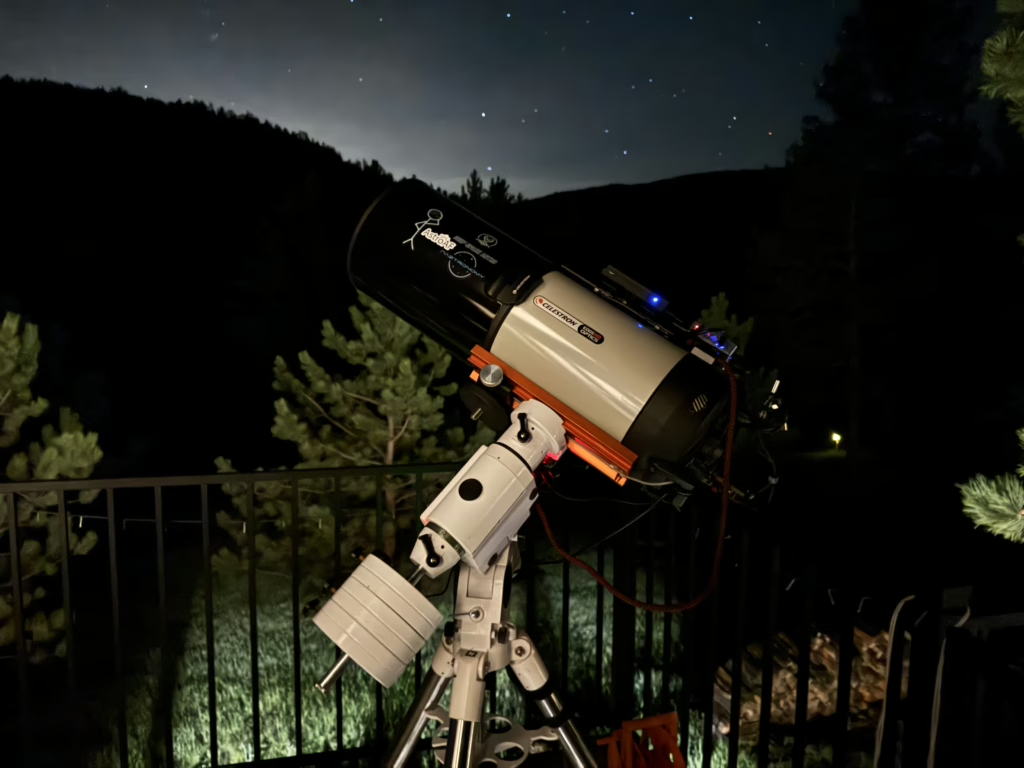
I travel to Colorado to a Bortle 3 location with my wife, celebrating 30 years anniversary! She actually set this trip up to a Bortle 3 dark sky location to a cabin in the mountains! How excellent is that! We vlog our travel adventure and some beautiful scenery on the way out and especially in the area we were staying! A beautiful cabin nestled in the mountains at a place called Big Elk Meadows. The views were spectacular! We had a lot of cloud cover but then the skies opened up to pristine black velvet and diamonds! The Milkyway could be seen with naked eye, it was awe inspiring as it always is! I was able to get a lot of data on my dark nebula object target,
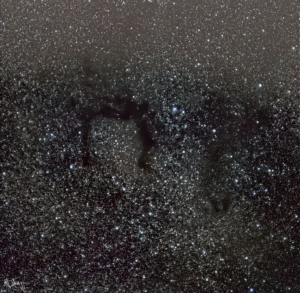
LDN 700 is a dark nebula in the southern reaches of Vulpecula, approximately 600 light-years from Earth. Unlike the glowing clouds of emission nebulae or the shimmering wisps of reflection nebulae, LDN 700 is defined by what it hides. It emits no visible light of its own and reflects none from nearby stars. It exists as a curtain against the cosmic backdrop, visible only because it blocks the stars behind it.
What is a Dark Nebula?
Dark nebulae are cold, dense accumulations of dust and gas in the interstellar medium. These regions are thick enough to obscure the background starlight, creating ghostly silhouettes in long-exposure astrophotography. While they may seem like voids, they are actually rich in molecular material—often the raw ingredients for future stars.
LDN 700 stands out as an example of this eerie beauty. Unlike bright nebulae, its presence is inferred by absence. The surrounding star field becomes patchy and irregular, with an unmistakable shape carved out of the light. It challenges the conventional idea that astronomical beauty is rooted in luminosity.
Discovery and Cataloging
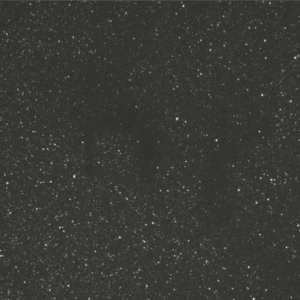
LDN 700 was cataloged in 1962 by Beverly T. Lynds, an American astronomer who created the seminal Catalogue of Dark Nebulae using optical survey plates from the Palomar Observatory. Each object was assigned a number and position based on opacity, location, and visual extent. LDN 700 appeared as one of many small patches of obscuration identified by eye, before the age of infrared surveys.
In the decades since, LDN 700 has been imaged in the infrared by surveys like 2MASS and WISE, offering limited views of the dust structure hidden within. However, in visible wavelengths, it remains opaque—emphasizing its classification as a quiescent, non-star-forming region.
Photographing the Absence
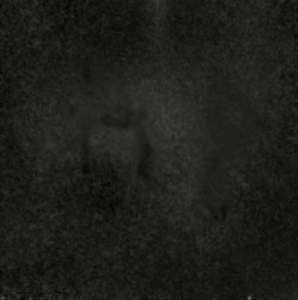
For astrophotographers, LDN 700 represents a rewarding challenge. Because there is no emission or reflection signal, the image must rely entirely on contrast with the surrounding stars and background gradient. Noise control, dynamic range compression, and careful masking are critical. Techniques like starless processing and multi-scale sharpening help reveal subtle filaments and boundaries in the dust cloud.
Processing such targets is often more of an art than a science—balancing aesthetic interpretation with scientific plausibility. Many deep-sky imagers describe the effort as meditative, drawing attention to structure rather than spectacle.
Stillness Before Creation
LDN 700 is not currently a site of star formation. It is quiet, inert, cold. But it is also not empty. These clouds are thought to represent an early stage in the stellar life cycle. Under the right conditions—instability, cooling, gravitational collapse—it may one day become a stellar nursery.
In that sense, it is a prelude: the darkness before the stars. An interstellar womb holding back its contents until the galaxy stirs it into motion. It reminds us that space is not just a void, but a tapestry woven of waiting, potential, and quiet complexity.
Travel VLOG
References
- Lynds, B. T. (1962). Catalogue of Dark Nebulae. Astrophysical Journal Supplement Series, 7, 1. https://ui.adsabs.harvard.edu/abs/1962ApJS….7….1L
- NASA/IPAC Infrared Science Archive. (n.d.). Retrieved from https://irsa.ipac.caltech.edu
- Palomar Observatory Sky Survey. (1950s). California Institute of Technology.
Leave a Reply